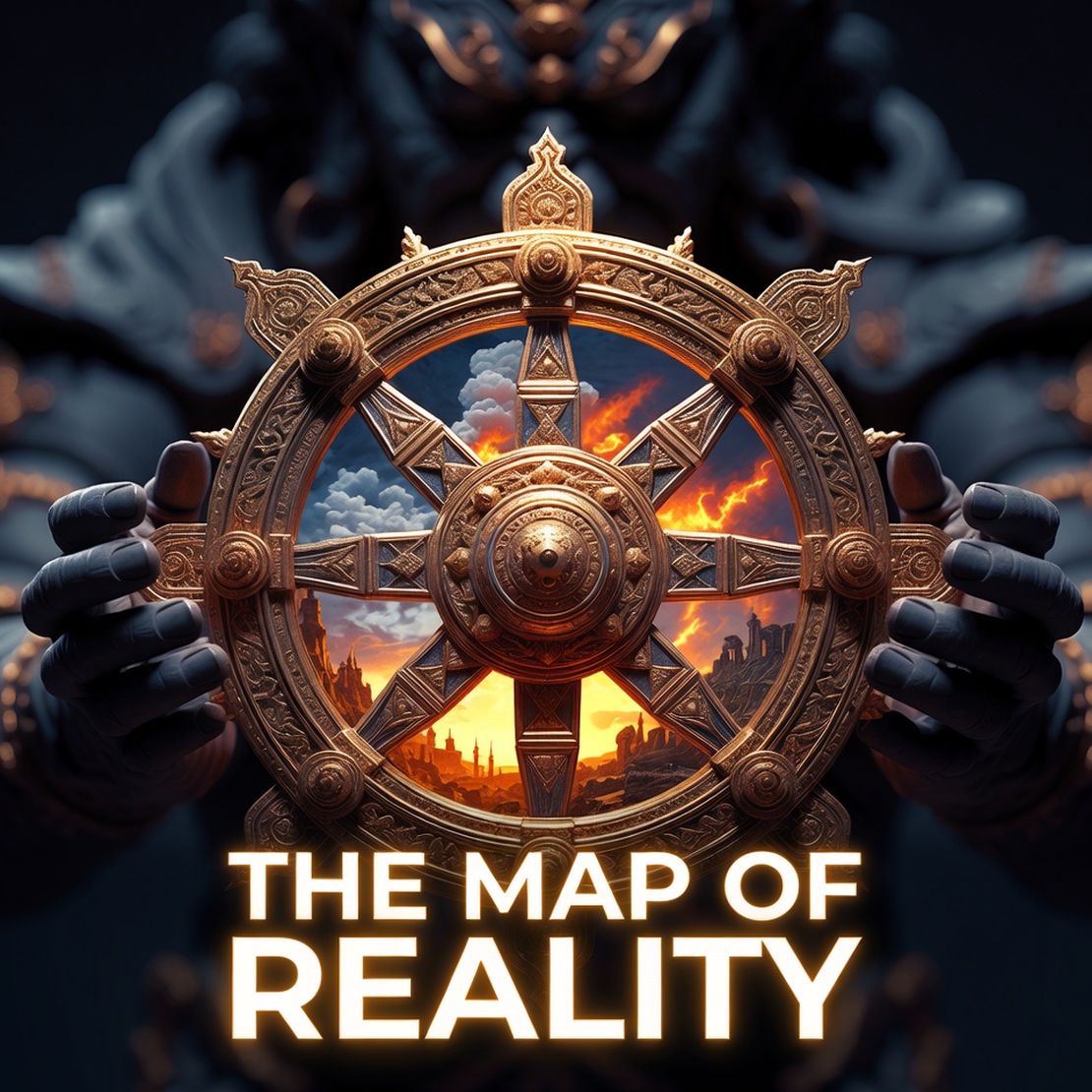
The Bhavacakra: Twelve Links of Dependent Origination and Stepping Off the Wheel
This is part 2 of a 2-part series. Read part 1: the three poisons and six realms of samsara.
Part one covered the outer structure of the wheel: the three poisons at the center and the six realms that beings cycle through. This part digs into the engine that keeps it all turning. The twelve links of dependent origination are the most important element of the Bhavacakra, and the hardest to explain briefly.
The Twelve Links of Dependent Origination
The outer rim of the wheel shows twelve images, each one representing a link in a chain. The chain is called pratityasamutpada, dependent origination, and it describes exactly how suffering comes into being.
The first link is ignorance, shown as a blind person walking with a stick. It is not knowing how things actually are. This creates volitional formations, pictured as a potter shaping clay. Those are the habits and karmic patterns we build from that ignorance.
Next comes consciousness, a monkey grasping a branch. This is the awareness that arises at conception, conditioned by everything that came before. Then name-and-form, two people in a boat. Mind and body come together into a specific being. After that, the six sense bases, an empty house with six windows. The five senses plus the mind are ready to make contact with the world.
Contact comes next, two people embracing. A sense meets an object, and experience arises. This leads to feeling, a man with an arrow in his eye. Pleasant, unpleasant, or neutral. Then craving, a person drinking. The thirst for more of what feels good and less of what does not.
Clinging follows, a monkey reaching for fruit. Grasping at what we crave, holding on. This creates becoming, a pregnant woman. The momentum of clinging leads toward a new existence. Then birth, a woman giving birth. Entry into a new life. And finally aging-and-death, a corpse being carried. All of it ends and the cycle begins again.
What I find remarkable about this list is how each link depends on the one before it. You cannot feel craving without first having feeling. You cannot have feeling without contact. You cannot have contact without the sense bases. Work backwards far enough and you arrive at ignorance, the beginning of the chain. It is a recipe for suffering, written in twelve steps.
But here is the thing: if any link is cut, the whole chain collapses. No craving means no clinging. No clinging means no becoming. No becoming means no birth. And the parallel in Stoicism is obvious. The path to freedom runs through letting go of what you grasp at.
Tracing the Chain Backwards
The story of the Buddha’s enlightenment under the Bodhi tree is, in technical terms, a debugging session. He traced the chain of dependent origination backwards to find its origin. Where does aging-and-death come from? Birth. Where does birth come from? Becoming. Link by link he worked his way back until he reached ignorance, and then he asked: what is the end of ignorance? Clear seeing.
Clear seeing is what the Bhavacakra is designed to produce. Every detail of the wheel is meant to provoke recognition, not just intellectual understanding. When you see the pig, the rooster, and the snake at the center, you are supposed to recognize them in yourself.
This is where the Bhavacakra differs from a Taoist map of inner alchemy or a Hindu cosmological diagram. Those maps describe the universe. The Bhavacakra describes the mind.
Stepping Off the Wheel
Nirvana is not a place you go. It is what happens when the chain stops. When ignorance is replaced by clear seeing, the conditions for the next link no longer exist. The chain unwinds. There is nothing left to fuel another round.
The Buddha described this in terms that sound almost mechanical. When this is, that is. When this is not, that is not. It is cause and effect, applied to the mind. There is no divine intervention needed.
In practice, this means paying attention to where the chain is operating in your own experience. I notice craving arise, and I can either feed it or watch it pass. That moment of awareness is a break in the chain. Most of the time I feed it, because that is what I have trained myself to do. But seeing the choice at all is the beginning of freedom. This kind of awareness is the same kind of attention you cultivate in mushin, or no-mind, where you stop interposing your thoughts between yourself and reality.
What This Map Means for Modern Life
I keep coming back to the Bhavacakra because it diagnoses something I see everywhere. The six realms show up in my daily life as emotional states, sometimes shifting within a single hour. When I am compulsively checking notifications, I am in the hungry ghost realm. When I compare myself to people on social media, I am in the demigod realm.
The twelve links describe how small moments of unawareness compound into patterns of suffering. I check my phone first thing in the morning. I feel a little anxious. I want the feeling to go away. I scroll for twenty minutes. That creates momentum toward doing the same thing the next day. The chain is real, and I can feel it operating in my own habits.
What the Bhavacakra offers is not a belief system. It is a way of looking at your own mind. You do not have to accept rebirth or karma in a literal sense to find the map useful. You just have to be willing to notice how craving and ignorance drive your behavior.
The twelve links also map surprisingly well onto what we now know about neuroplasticity. Every time you follow craving with clinging, you strengthen a neural pathway. Each moment of awareness, each choice not to feed the craving, weakens the old pathway. You are not fighting some abstract spiritual problem. You are rewiring your brain, one link at a time.
Closing Thoughts
Every time I study the Bhavacakra, I find something I missed before. But the core message is simple. We suffer because we are ignorant of how our own minds work. We grasp at what feels good and push away what does not. That creates karma, which creates momentum, which keeps the cycle going. The way out is to see the chain clearly and cut it at the source.
Yama holds the wheel in his claws. Everything inside it is impermanent, including every state of mind I have ever been in. All of it passes. Watching that passing is what the wheel teaches.
Frequently Asked Questions
What are the twelve links of dependent origination?
Ignorance, volitional formations, consciousness, name-and-form, six sense bases, contact, feeling, craving, clinging, becoming, birth, and aging-and-death. Each link depends on the one before it.
How does cutting one link stop the cycle?
If craving stops, clinging cannot arise. If clinging stops, becoming stops. No becoming means no new birth. The chain unwinds from the point of the cut.
Do I need to be Buddhist to benefit from the Bhavacakra?
No. The wheel describes psychological patterns that anyone can observe in their own mind. You do not need to accept any beliefs to find the map useful.
Read previous: The Bhavacakra Part 1: Understanding the Wheel of Life, Three Poisons, and Six Realms
Related Posts
Hinduism Explained: Core Beliefs, Origins, and Practices of Sanātana Dharma
Hinduism Explained: Core Beliefs, Origins, and Practices of Sanātana Dharma Hinduism is frequently cited as the world’s oldest active religion, boasting roots that stretch back over 4,000 years. With over 1 billion followers globally—making it the third-largest religion—it is a faith of immense depth and diversity, with many parallels to other ancient traditions like Daoism. Approximately 95% of Hindus reside in India and Nepal, yet its philosophical influence reaches every corner of the globe.
Read More
Miyamoto Musashi's Dokkōdō: The Life of a Ronin and Principles 1-7
Miyamoto Musashi’s Dokkōdō: The Life of a Ronin and Principles 1-7 I remember the first time I read the Dokkōdō. It was late at night, I was feeling stuck, and I stumbled across this list of 21 precepts written by a 17th century Japanese swordsman. I expected a warrior code about fighting and honor. What I found was something stranger: a guide to being alone, a philosophy of radical self-reliance, and a surprisingly practical system for navigating modern life.
Read MoreDokkōdō Principles 8-18: Purpose, Resilience, and Honor
Dokkōdō Principles 8-18: Purpose, Resilience, and Honor This is the second part of my breakdown of Miyamoto Musashi’s Dokkōdō. Read Part 1: Life and Principles 1-7 first if you haven’t already. Part 3: Applying the Dokkōdō to Modern Life covers the final principles and practical application.
Read More