The Bhavacakra: A Guide to Buddhism’s Wheel of Life and Reality
I came across the Bhavacakra for the first time in a book about Tibetan Buddhist art, and it stopped me cold. Not because it was beautiful, though it is. What got me was how much information the thing packs into a single image. I stared at it for maybe ten minutes before I started to understand what I was looking at. The Wheel of Life, or Wheel of Becoming, is a map of everything Buddhism says about why we suffer and how we can stop. It is also one of the most efficient visual teaching tools I have ever seen.
The Bhavacakra does not just describe the world. It describes the mechanism that keeps us spinning through it, life after life, and it points to the one way out. I read somewhere that the best maps do not just show you where you are. They show you how to get where you are not yet. The Bhavacakra does both. In that sense, it functions like the cosmological models of Hinduism, but with a sharper focus on the psychological chain that binds us. I have spent a lot of time thinking about what this wheel says about my own life, and I want to walk through it piece by piece.
What the Wheel Actually Shows
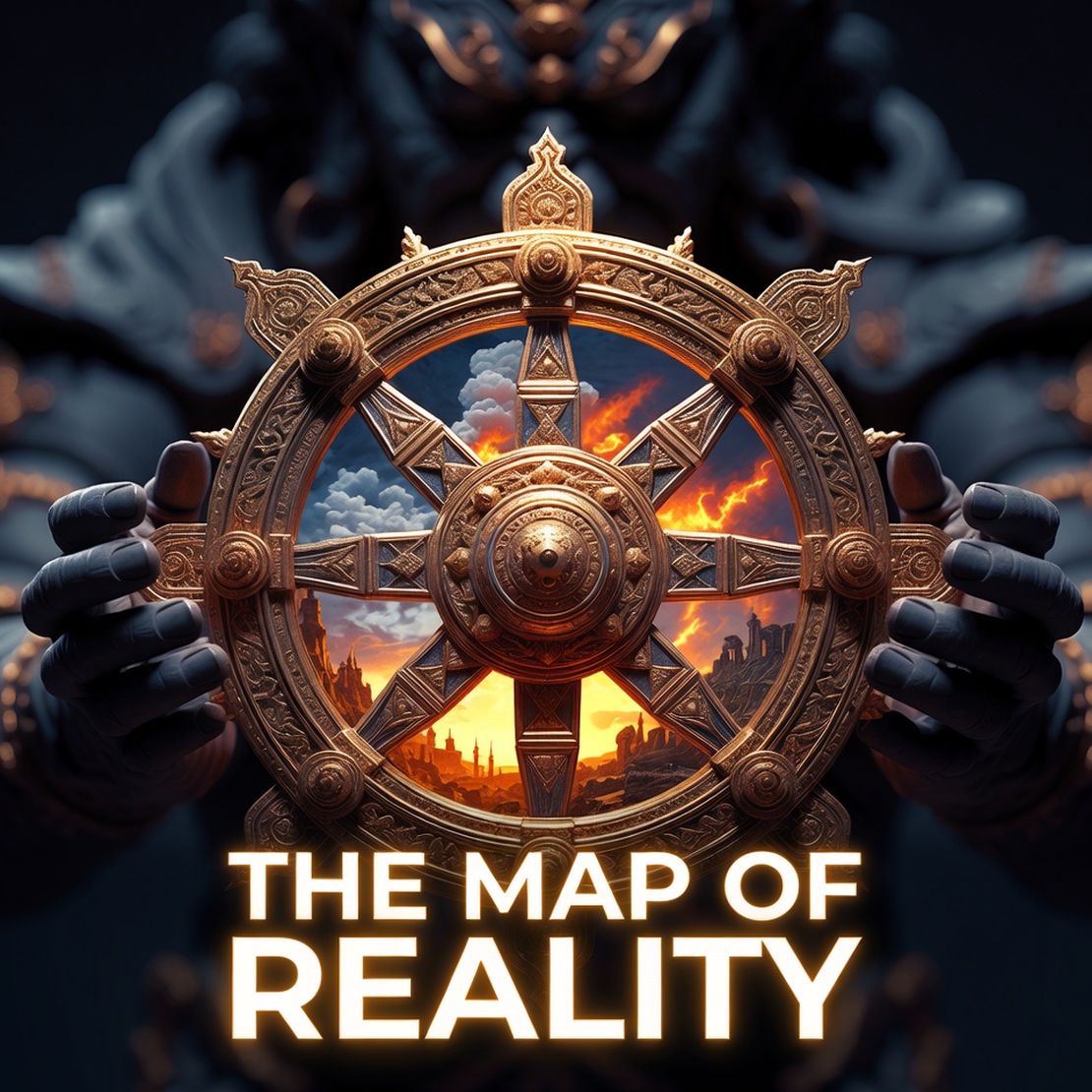
The Bhavacakra is a circular diagram held in the hands of a terrifying figure. That figure is Yama, the lord of death. The fact that death grips the wheel from the outside is the first teaching: everything inside this circle is impermanent. Every realm, every state of being, every pleasure and pain, it all ends.
The wheel itself has four concentric layers. At the very center is a small hub containing three animals. The next ring out shows the karmic trajectory, a path divided into light and dark halves. On one side, beings rise upward toward happier states. On the other, they fall toward suffering. This is not a judgment from some external judge. It is just cause and effect playing out. Act from greed and aversion, and the momentum carries you down. Act from generosity and clarity, and it carries you up.
The third ring, the largest, is divided into six segments representing the six realms of samsara. And on the outer rim, twelve small images illustrate the chain of dependent origination, the twelve links that keep the whole cycle in motion.
I like to think of the Bhavacakra as a psychological machine. The three animals at the center are the fuel. The six realms are the possible destinations. The twelve links are the gears that turn everything. Pull one piece out, the whole thing stops.
The Three Poisons at the Center
At the hub of the wheel, three animals chase each other in a circle. A pig, a rooster, and a snake, each biting the tail of the animal in front. These represent the three root poisons: ignorance, greed, and aversion.
The pig is ignorance. Not stupidity, but a fundamental not-seeing. The pig does not recognize what things actually are. In Buddhist thought, this is the deepest problem: we misperceive reality at a basic level. This is similar to what Alan Watts describes as map-territory confusion, where we mistake our concepts about the world for the world itself.
The rooster is greed and craving. The bird chases after what it wants, never satisfied for long. I see this in my own life more than I would like. The feeling that the next achievement, the next purchase, the next distraction will finally be enough. It never is.
The snake is aversion and anger. It clings to what it hates, reacts with aggression when threatened. Between the rooster reaching out and the snake pushing away, you get the basic rhythm of an unexamined life: grab what you want and fight what you do not, staying blind to the whole pattern.
These three animals chase each other in a circle because they feed each other. Ignorance creates craving. Craving leads to frustration, which creates aversion. Aversion reinforces ignorance. Round and round.
The Six Realms
Surrounding the hub is the outer circle of the wheel, divided into six sections. Each one represents a realm of existence where beings can be reborn. I used to think of these as literal places, but the deeper I study them, the more they look like psychological states that everyone experiences in daily life.
The god realm is a state of pleasure and ease. Beings here experience prolonged happiness, but they are so comfortable they never feel motivated to seek liberation. The problem is not suffering in this realm. It is the absence of any reason to change. I have felt this. When life is going well, when I am healthy and things are easy, I do not meditate or reflect. I just coast.
The demigod realm is a state of ambition and envy. The demigods can see the gods enjoying their pleasure, but they cannot reach it themselves. So they spend their lives fighting, competing, trying to get what others have. I see this one in the culture around me constantly. The endless hustle, the comparing, the feeling that someone else has something I deserve.
The human realm is the most interesting, and in Buddhist thought, the most fortunate. Humans experience a mix of pleasure and pain, enough suffering to feel motivated and enough ease to have the mental space to practice. This balance is considered incredibly rare. In fact, a common Buddhist analogy compares the chance of being born human to a blind sea turtle surfacing once every hundred years and sticking its head through a single floating ring. The human realm is where liberation becomes possible because only here do we have enough awareness to see the chain and enough suffering to want to break it.
The animal realm is a state driven by basic survival. Eat, sleep, mate, avoid danger. No reflection, no bigger picture. I see this when I am running on autopilot, scrolling through feeds, reacting to whatever comes next without any real awareness.
The hungry ghost realm is craving without satisfaction. These beings have huge bellies and tiny mouths, so they can never consume enough to feel full. I know this state well. It is the feeling of eating when I am not hungry, buying things I do not need, chasing dopamine hits that fade in seconds.
The hell realm is intense suffering, aggression, and fear. In a psychological reading, this is the state of being consumed by rage, trauma, or despair. It is not permanent in Buddhism (no realm is), but while you are in it, it feels endless.
The point of showing all six realms together is that none of them are stable. Every being in every realm will eventually die and be reborn elsewhere based on their karma. The wheel keeps turning. The only way out is not to land in a better realm, but to understand the mechanism that keeps the wheel spinning.
The Twelve Links of Dependent Origination
This is the most important part of the Bhavacakra, and the hardest to explain briefly. The outer rim of the wheel shows twelve images, each one representing a link in a chain. The chain is called pratityasamutpada, dependent origination, and it describes exactly how suffering comes into being.
The first link is ignorance, shown as a blind person walking with a stick. It is not knowing how things actually are. This creates volitional formations, pictured as a potter shaping clay. Those are the habits and karmic patterns we build from that ignorance.
Next comes consciousness, a monkey grasping a branch. This is the awareness that arises at conception, conditioned by everything that came before. Then name-and-form, two people in a boat. Mind and body come together into a specific being. After that, the six sense bases, an empty house with six windows. The five senses plus the mind are ready to make contact with the world.
Contact comes next, two people embracing. A sense meets an object, and experience arises. This leads to feeling, a man with an arrow in his eye. Pleasant, unpleasant, or neutral. Then craving, a person drinking. The thirst for more of what feels good and less of what does not.
Clinging follows, a monkey reaching for fruit. Grasping at what we crave, holding on. This creates becoming, a pregnant woman. The momentum of clinging leads toward a new existence. Then birth, a woman giving birth. Entry into a new life. And finally aging-and-death, a corpse being carried. All of it ends and the cycle begins again.
What I find remarkable about this list is how each link depends on the one before it. You cannot feel craving without first having feeling. You cannot have feeling without contact. You cannot have contact without the sense bases. Work backwards far enough and you arrive at ignorance, the beginning of the chain. It is a recipe for suffering, written in twelve steps.
But here is the thing: if any link is cut, the whole chain collapses. No craving means no clinging. No clinging means no becoming. No becoming means no birth. And the parallel in Stoicism is obvious. The path to freedom runs through letting go of what you grasp at.
Tracing the Chain Backwards
The story of the Buddha’s enlightenment under the Bodhi tree is, in technical terms, a debugging session. He traced the chain of dependent origination backwards to find its origin. Where does aging-and-death come from? Birth. Where does birth come from? Becoming. Link by link he worked his way back until he reached ignorance, and then he asked: what is the end of ignorance? Clear seeing.
Clear seeing is what the Bhavacakra is designed to produce. Every detail of the wheel is meant to provoke recognition, not just intellectual understanding. When you see the pig, the rooster, and the snake at the center, you are supposed to recognize them in yourself. When you study the twelve links, you are supposed to see how they operate in your own moments of suffering.
This is where the Bhavacakra differs from a Taoist map of inner alchemy or a Hindu cosmological diagram. Those maps describe the universe. The Bhavacakra describes the mind. It is a map of how perception itself works, drawn in the language of myth and symbol.
Stepping Off the Wheel
Nirvana is not a place you go. It is what happens when the chain stops. When ignorance is replaced by clear seeing, the conditions for the next link no longer exist. The chain unwinds. There is nothing left to fuel another round.
The Buddha described this in terms that sound almost mechanical. When this is, that is. From the arising of this comes the arising of that. When this is not, that is not. From the cessation of this comes the cessation of that. It is cause and effect, applied to the mind. There is no divine intervention needed. No one saves you from the cycle but yourself, and you save yourself by seeing clearly.
In practice, this means paying attention to where the chain is operating in your own experience. I notice craving arise, and I can either feed it or watch it pass. That moment of awareness is a break in the chain. Most of the time I feed it, because that is what I have trained myself to do. But seeing the choice at all is the beginning of freedom. The chain only has power when you do not notice it turning.
This kind of awareness is not abstract. It is the same kind of attention you cultivate in mushin, or no-mind, where you stop interposing your thoughts between yourself and reality. You just see what is there.
What This Map Means for Modern Life
I keep coming back to the Bhavacakra because it diagnoses something I see everywhere but cannot name otherwise. The six realms show up in my daily life as emotional states, sometimes shifting within a single hour. When I am compulsively checking notifications, I am in the hungry ghost realm. When I compare myself to people on social media, I am in the demigod realm. When I am just reacting, not thinking, I am in the animal realm.
The twelve links describe how small moments of unawareness compound into patterns of suffering. I check my phone first thing in the morning (contact with a stimulus). I feel a little anxious (feeling). I want the feeling to go away (craving). I scroll for twenty minutes (clinging). That creates momentum (becoming) toward doing the same thing the next day. The chain is real, and I can feel it operating in my own habits.
What the Bhavacakra offers is not a belief system. It is a way of looking at your own mind. You do not have to accept rebirth or karma in a literal sense to find the map useful. You just have to be willing to notice how craving and ignorance drive your behavior.
I find that similar to the kind of introspection you see in Taoist practices of circulating consciousness, where the point is not to believe something but to pay attention to how your own mind works. The Bhavacakra is a tool for that same kind of attention.
The twelve links also map surprisingly well onto what we now know about habit formation and neuroplasticity. Every time you follow craving with clinging, you strengthen a neural pathway. The chain becomes physically encoded in your brain. The good news is that the same plasticity that builds the chain can also dismantle it. Each moment of awareness, each choice not to feed the craving, weakens the old pathway. You are not fighting some abstract spiritual problem. You are rewiring your brain, one link at a time.
A friend of mine once told me that studying Buddhist philosophy made him more anxious, not less, because he started seeing suffering everywhere. I know what he meant. At first, the twelve links can feel like a prison. Every habit is a chain, every craving a link. But that passes. The point is not to catalog your suffering. It is to see that the chain has a beginning, and beginnings can be undone.
The wheel does not change until you do. That is the hard part and also the hopeful one.
The Bhavacakra as a Living Teaching
I should mention that the Bhavacakra is not just a historical artifact. In Tibetan Buddhist monasteries, these paintings are still used as teaching tools. They hang on the walls of monastery entrances so that everyone who walks past sees them. Monks use them to explain karma to laypeople who may not be able to read. The images do the work that words cannot.
I find this practical side of the Bhavacakra moving. It was never meant to be studied in isolation by scholars. It was meant to help real people see their own minds more clearly. A farmer in 12th century Tibet and a person scrolling through social media in 2026 might recognize different things in the wheel, but the basic pattern is the same. Craving leads to grasping. Grasping leads to momentum. Momentum leads to more of the same.
Closing Thoughts
Every time I study the Bhavacakra, I find something I missed before. The details are dense, the symbolism layered. But the core message is simple. We suffer because we are ignorant of how our own minds work. We grasp at what feels good and push away what does not. That creates karma, which creates momentum, which keeps the cycle going. The way out is to see the chain clearly and cut it at the source.
Yama holds the wheel in his claws. Everything inside it is impermanent, including every state of mind I have ever been in. The peace I sometimes feel, the frustration I often feel, the craving I almost always feel. All of it passes. Watching that passing is what the wheel teaches.
I do not think you need to be a Buddhist to benefit from this map. You just need to be someone who has noticed that the usual strategies for happiness do not seem to work. The Bhavacakra offers an explanation for why, and a place to start looking more carefully. That is what maps are for, in the end. Not to tell you where you are, but to help you see that you can move.
Related Posts

Dokkōdō Principles 8-18: Purpose, Resilience, and Honor
Dokkōdō Principles 8-18: Purpose, Resilience, and Honor This is the second part of my breakdown of Miyamoto Musashi’s Dokkōdō. Read Part 1: Life and Principles 1-7 first if you haven’t already. Part 3: Applying the Dokkōdō to Modern Life covers the final principles and practical application.
Read More
Stoicism in Practice: Daily Exercises, Common Misconceptions and FAQ
This is part 2 of a two-part series on Stoic wisdom. Read part 1: The Stoic Framework for Peace ←
Read MoreThe Bhavacakra: Twelve Links of Dependent Origination and Stepping Off the Wheel
The Bhavacakra: Twelve Links of Dependent Origination and Stepping Off the Wheel This is part 2 of a 2-part series. Read part 1: the three poisons and six realms of samsara.
Read More