
The MAP Framework: Aligning Your Daily Tasks with Long-Term Goals
This is part 1 of a two-part series. Read part 2 here: Time Blocking and Deep Work: Execution Strategies for Maximum Productivity.
I used to think productivity was about doing more. Cram more tasks into each day. Wake up earlier. Answer emails faster. The harder I pushed, the less I got done. I would finish Friday exhausted, look back at the week, and realize the important stuff had been pushed to Monday again.
That changed when I started using a structured weekly planning system. The difference is not about working harder. It is about building a system that filters out the noise so the important work actually gets done.
Based on insights from Matt Essam of The Futur, this guide covers the MAP framework, brain dumping, and the Impact vs Effort matrix. I have been using this system for years, and it is the single biggest reason I can do more in a week than I used to do in a month.
The MAP Framework: Aligning Vision with Action
Productivity is meaningless if it does not move you toward a specific destination. To make sure your daily grind contributes to your bigger picture, you need structure. The MAP framework was created by Matt Essam, a strategist who worked with The Futur. I first heard about it on their podcast, and it changed how I think about goal setting.
The idea is simple: most productivity systems start at the wrong level. They jump straight to tasks without asking whether those tasks matter. MAP fixes that by breaking ambitions into three layers.
M (Milestones). Measurable, high-level goals. Not vague aspirations like “grow the business” but specific numbers. Revenue targets, subscriber counts, client acquisition goals. A milestone should be something you can look at and know, without interpretation, whether you hit it.
A (Actionable Projects). The concrete things that need to be built or finished to reach each milestone. If the milestone is “ten new clients this quarter,” the projects might include a landing page redesign, a cold email campaign, and a referral program.
P (Process/Tasks). The daily actions that move each project forward. Not everything needs to be done at once, but every task should trace back to a project that traces back to a milestone.
I keep my MAP in a simple text file. Every Monday I review it before planning the week. This keeps me honest. You can see my approach to goal setting in the goal achieving blueprint for more detail.
How MAP differs from OKRs
MAP and OKRs share some DNA, but MAP includes the task layer more directly. OKRs give you objectives and key results and stop there. MAP adds the projects and daily process layer underneath, which makes it easier to translate strategy into Monday morning action.
Mental Clarity: The Power of the Brain Dump
Your brain is designed for having ideas, not holding them. That sounds like a motivational poster, but it is backed by research. The Zeigarnik effect, first studied by Russian psychologist Bluma Zeigarnik in the 1920s, shows that unfinished tasks occupy mental space until they are completed or written down.
The Solution
I do a brain dump every Sunday evening. I take a blank page and write down everything in my head. Tasks, worries, ideas, calls I need to make, things I am afraid of forgetting. No filtering, no prioritization. Just getting it out.
A study published in the Journal of Experimental Psychology found that writing down intrusive thoughts before a task improved performance significantly. The act of externalizing reduces the cognitive load on your working memory. It clears your mental RAM.
After the brain dump, I categorize everything. Some items go to my calendar. Some go to a “someday” list. Some get deleted. But the first step is always just getting it out of my head. If you struggle with constant mental clutter, my article on why procrastination is really about emotional regulation might help.
Strategic Prioritization: Impact vs Effort
Once everything is out of your head, the next step is sorting it. I use the Impact vs Effort matrix, a variation of the Eisenhower Matrix. The original comes from Dwight D. Eisenhower, who said “What is important is seldom urgent and what is urgent is seldom important.”
Eisenhower developed this framework during his time as Supreme Commander of Allied Forces in World War II. He needed a way to sort through the flood of decisions that crossed his desk. The matrix he used became the basis for most modern prioritization systems, including Stephen Covey’s time management matrix in The 7 Habits of Highly Effective People.
The Impact vs Effort version is simpler for weekly planning. You sort each task into four boxes:
- High Impact, Low Effort: Do these first. These are your quick wins. A five-minute email that could land a meeting. A small fix that removes a bottleneck for someone else. These build momentum because they are easy and they matter.
- High Impact, High Effort: Schedule these. Major projects that require deep focus. A proposal draft. A feature launch. These go into your time blocks for the week.
- Low Impact, Low Effort: Delegate or batch. Routine emails, standard approvals. Do not let these eat up your peak energy hours.
- Low Impact, High Effort: Delete immediately. Time vampires. That report nobody reads. That meeting that should have been an email.
I ask one question for every task: “Does this move the needle toward my MAP milestones?” If not, it gets cut. Tim Ferriss talks about this in The 4-Hour Workweek: elimination is more powerful than optimization.
How MAP Compares to Other Productivity Systems
No single system covers everything. Here is how MAP stacks up against the most popular approaches and when each one makes sense.
GTD (Getting Things Done by David Allen): GTD is excellent for capture and organization. Its weakness is that it treats all tasks as equal. MAP adds the strategic layer on top. I use GTD capture methods during the week for quick capture and MAP for weekly planning.
Pomodoro Technique: Pomodoro is great for execution but bad for strategy. Working in 25 minute bursts does not help you decide what to work on. MAP tells you what matters. Pomodoro tells you how to execute it. They work well together.
Deep Work (Cal Newport): Newport’s framework is about protecting focused time for cognitively demanding tasks. MAP aligns with this because high impact, high effort tasks require deep work. The difference is MAP gives you a framework for deciding what deserves that deep time.
Kanban: Visual task management that works well for ongoing workflows. I use a simple Kanban board alongside my MAP. The board handles the week. MAP handles the quarter.
The key is to pick the right tool for the job. MAP gives you strategic direction. You layer other methods on top for execution.
Continue reading: Time Blocking and Deep Work: Execution Strategies for Maximum Productivity covers how to schedule your time, find your golden hour, and build a weekly routine that sticks.
Related Posts

The Effective Executive: 5 Key Strategies for Leadership Mastery
The Effective Executive: 5 Key Strategies for Leadership Mastery In the world of management and personal productivity, few works are as influential as Peter Drucker’s The Effective Executive. The core premise of Drucker’s philosophy challenges the traditional view of success: intelligence and hard work alone are not enough. To truly succeed, one must cultivate the habit of effectiveness.
Read MoreTime Blocking and Deep Work: Execution Strategies for Maximum Productivity
Time Blocking and Deep Work: Execution Strategies for Maximum Productivity This is part 2 of a two-part series. Read part 1 here: The MAP Framework: Aligning Your Daily Tasks with Long-Term Goals.
Read More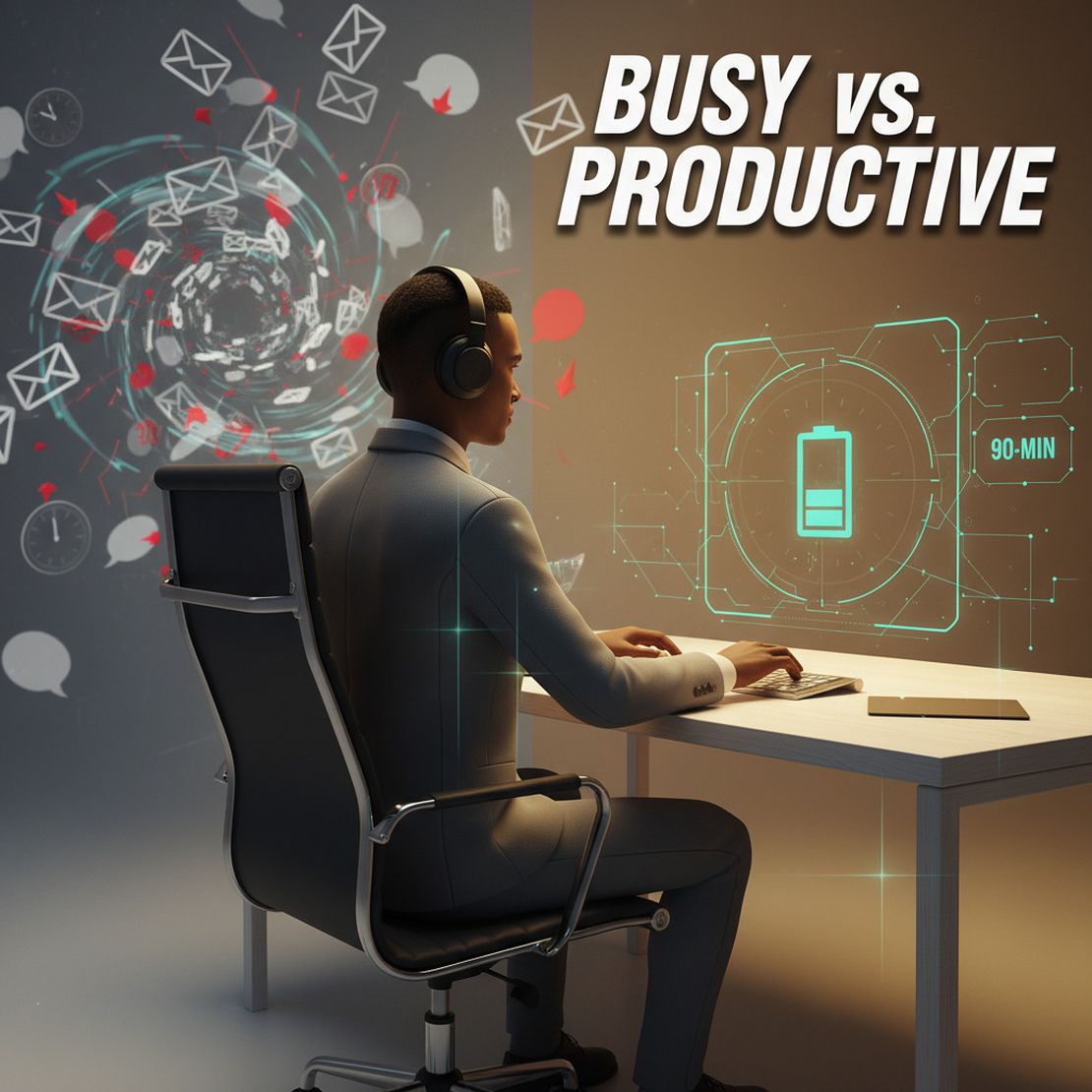
Master Your Workflow: 4 Proven Strategies to Stop Being "Busy" and Start Being Productive
Master Your Workflow: 4 Proven Strategies to Stop Being “Busy” and Start Being Productive In the modern professional landscape, “busy” is often mistaken for “productive.” Most of us are drowning in a relentless stream of emails, Slack messages, and meetings. We reach the end of the day exhausted, yet with a nagging feeling that we haven’t accomplished our most significant work.
Read More