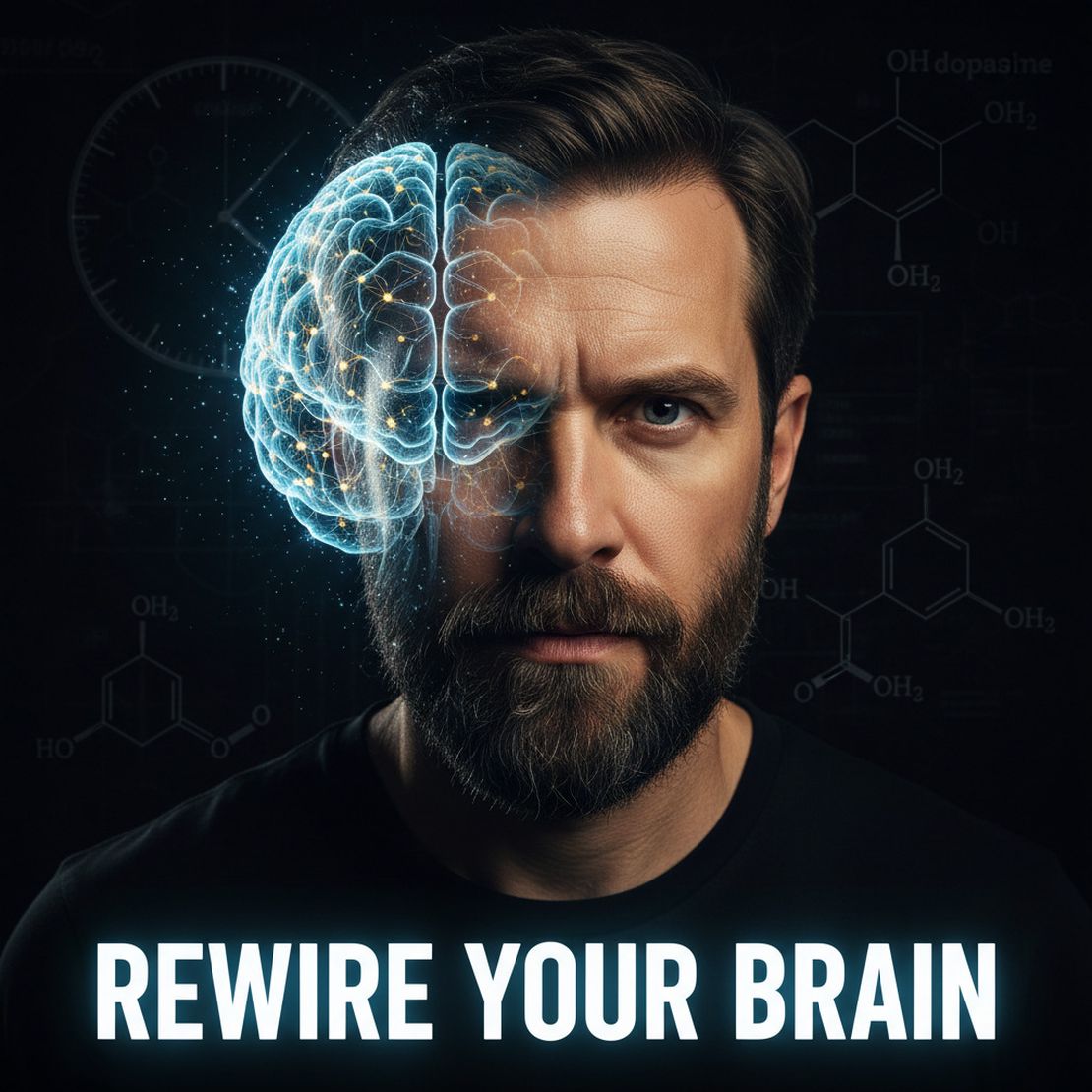
The Neuroscience of Habits: Dr. Andrew Huberman’s Guide to Building and Breaking Behaviors
Building lasting habits—or breaking detrimental ones—is often treated as a matter of pure willpower. However, Dr. Andrew Huberman, a renowned neuroscientist, argues that habit formation is fundamentally a biological process rooted in the nervous system.
By understanding the mechanics of neuroplasticity and leveraging your body’s natural chemical states, you can move from “grinding” through tasks to achieving automaticity. Here is a comprehensive guide to the neuroscience of making and breaking habits, based on Dr. Huberman’s research.
The Biology of Habits: How the Brain Changes
To control your behavior, you must first understand the machinery behind it.
Neuroplasticity
At the core of habit formation is neuroplasticity—the nervous system’s ability to reorganize itself in response to experience. I’ve covered why your brain is like a muscle and what that means for growth in more detail. This biological rewiring is what allows us to learn new skills and behaviors.
Reflex vs. Habit
It is important to distinguish between the two:
- Reflexes are automatic and non-learned.
- Habits are learned behaviors that become automatic over time.
Goal-Based vs. Identity-Based
Huberman highlights a critical shift in psychology. Initially, habits are Goal-Based (performing an action to get a specific outcome). The ultimate objective is to become Identity-Based (performing an action because it is simply part of who you are).
Note: The nervous system finds it significantly easier to learn to do something new than to stop doing something impulsive. This is why replacing habits is often more effective than simply quitting them.
The Science of Habit Formation
Debunking the Time Myth
Popular culture often cites the “21-day rule” or “60-day rule” for forming habits. However, scientific literature (such as Lally et al., 2010) reveals immense variability. Depending on the individual and the difficulty of the task, forming a habit can take anywhere from 18 to 254 days.
Mastering “Limbic Friction”
The primary metric for habit difficulty is Limbic Friction. This represents the activation energy required to overcome lethargy or anxiety to start a task — the same concept explored in how to train your brain to actually enjoy hard work.
- High Limbic Friction: Requires heavy conscious effort (willpower).
- Automaticity: The state where limbic friction is near zero.
The Visualization Tool
To lower limbic friction, use Procedural Memory Visualization. Before performing a new habit, close your eyes and mentally walk through the specific steps (e.g., putting on running shoes, opening the door). This “pre-fires” the neurons required for the task, reducing the biological resistance when you physically execute it.
The Mechanism: Task Bracketing
To make a habit stick regardless of your mood or environment, you must engage the Dorsolateral Striatum (DLS) in the basal ganglia.
This area uses Task Bracketing to “timestamp” a habit. The brain fires neural activity at the very beginning and the very end of the action, effectively creating a neurological bookmark.
- Context Independence: A properly bracketed habit can be performed even when you are tired, stressed, or in a new location.
- The Goal: Move behavior from the prefrontal cortex (high effort) to the basal ganglia (reflexive).
Phase-Based Habit Scheduling
Rather than forcing habits at arbitrary times (like “8:00 AM sharp”), Huberman suggests aligning tasks with your circadian biology.
Phase 1: 0–8 Hours After Waking
- Biological State: High Norepinephrine, Epinephrine, and Dopamine. Body temperature is rising.
- Best Actions: High-Friction Habits. Your brain is chemically primed for focus and overcoming resistance.
- Examples: Intense exercise, deep work, or ice baths.
- Tip: View sunlight immediately upon waking to anchor this phase — which is a key part of the 15-minute morning routine that science says changes everything.
Phase 2: 9–15 Hours After Waking
- Biological State: Dopamine drops, Serotonin rises, and Cortisol decreases.
- Best Actions: Habit Consolidation. Focus on soothing, low-friction habits.
- Examples: Journaling, creative brainstorming, music practice, or meditation.
Phase 3: 16–24 Hours After Waking (Deep Sleep)
- Significance: This is when neuroplasticity actually occurs. The rewiring of neural pathways happens during deep sleep and non-sleep deep rest, not during the practice itself.
- Action: Optimize your sleep environment (cool, dark room) to ensure the hard work of the day is locked in.
Dopamine and Reward Systems
You can hack your brain’s reward system to reinforce habits without becoming dependent on external treats.
Reward Prediction Error
Dopamine release is tied to expectation:
- Unexpected Reward: High dopamine release (Great for learning).
- Expected Reward: Moderate dopamine release.
- Missing Expected Reward: Dopamine crash (Pain/Frustration).
Dopamine Spotlighting
Do not wait until the task is finished to feel good. Practice Dopamine Spotlighting: consciously tell yourself, “This is hard, but I am doing it, and it is beneficial.” This releases dopamine during the friction, reinforcing the effort itself rather than just the result — a concept explored in depth in Master Your Motivation: The Science of Dopamine.
Random Intermittent Reinforcement
To make a habit incredibly robust, mimic the psychology of gambling:
- Don’t reward yourself every time.
- Flip a coin: If heads, enjoy a reward (a treat, a show). If tails, no reward. This keeps the dopamine system guessing and engaged, locking in the behavior much faster than consistent rewards.
The 21-Day Habit Installation System
Huberman proposes a structured approach to installing new behaviors:
- Selection: Choose 6 new habits to implement.
- Performance Window (Days 1–21): Attempt to complete these habits daily.
- Reality Check: You likely won’t hit all 6 every day. Aim for 4 to 5.
- Forgiveness: Never punish missed days; simply continue.
- Testing Phase (Days 22–42): Stop adding new habits. Assess which of the original 6 have become automatic.
- If they are easy, they are installed. If not, continue the cycle.
The Science of Breaking Bad Habits
Breaking a habit requires Long-Term Depression (weakening of synaptic connections). This is biologically difficult because established neural pathways are strong.
The “Positive Cargo” Technique
Simply telling yourself “Don’t do X” often creates a feedback loop that highlights the desire. Instead, disrupt the neural loop.
- The Strategy: If you engage in a bad habit, immediately follow it with a beneficial, low-friction action.
- Example: If you catch yourself doom-scrolling, immediately drop and do 5 pushups or drink a glass of water.
- The Mechanism: This creates a “double bind” for the brain. It begins to associate the bad habit with the “cost” of the extra work, disrupting the closed-loop firing sequence.
Key Takeaways
- Linchpin Habits: Identify one habit (like sleep or exercise) that makes all other habits easier.
- Leverage Biology: Tackle high-friction tasks in the first 8 hours of your day.
- Reward the Process: Use dopamine to value the effort, not just the outcome.
- Disrupt Bad Loops: Attach a good habit to the end of a bad one to break the neural sequence.
Related Posts

5 Ancient Learning & Memory Techniques to Supercharge Your Brain
5 Ancient Learning & Memory Techniques to Supercharge Your Brain I used to think having a bad memory was just something you lived with. I would forget names minutes after hearing them. I would read a book and struggle to recall what the first chapter was about by the time I finished the last one. Then I stumbled onto something that changed how I think about memory entirely.
Read More
Master Your Motivation: The Science of Dopamine & Huberman Protocols
Master Your Motivation: The Science of Dopamine & Huberman Protocols Understanding how your brain generates motivation is the key to unlocking consistent focus and drive. Based on the comprehensive “Dopamine Masterclass” by neuroscientist Dr. Andrew Huberman, this guide breaks down the biological mechanisms of dopamine and provides actionable protocols to harness it effectively.
Read More
6 Steps to Reinvent Yourself: The D.A.P.P.E.R. Framework for Success
6 Steps to Reinvent Yourself: The D.A.P.P.E.R. Framework for Success A few years ago I hit a wall. I was working hard and staying busy, telling myself I was making progress. But deep down I knew I was running in place. Same problems kept coming back. Same excuses. I kept thinking the next job or the next relationship would fix everything. It never did.
Read More