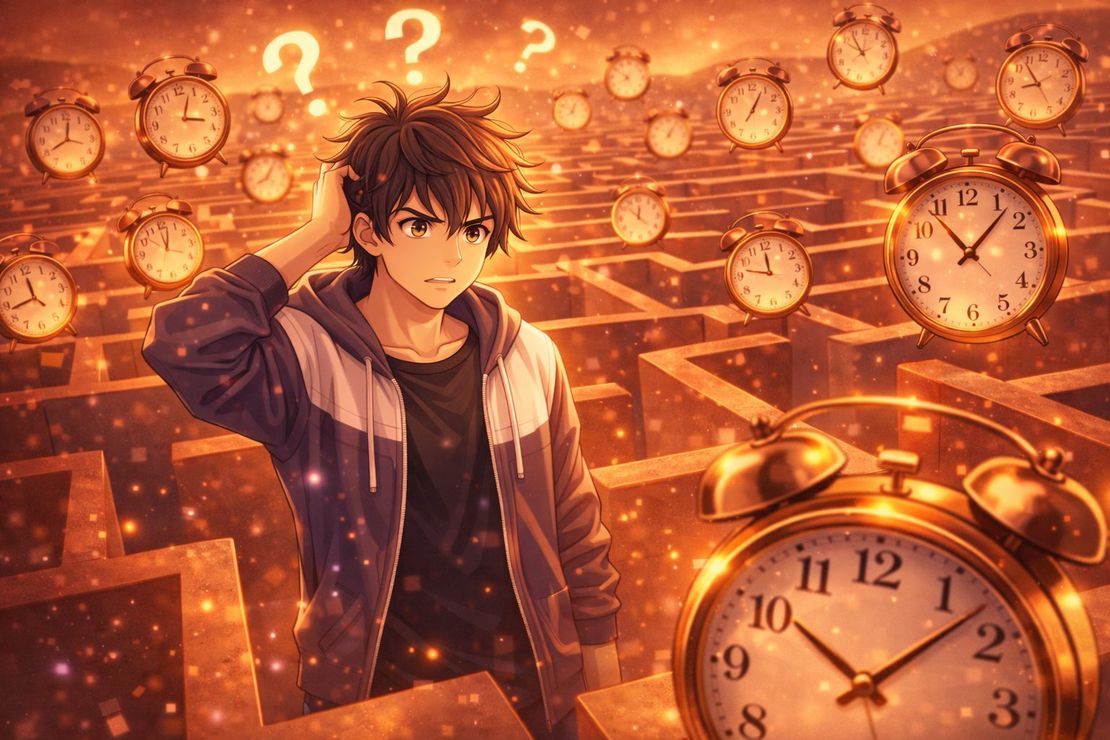
Why You Keep Procrastinating Even When It Feels Bad
Have you ever sat down to do work, known exactly what you needed to do, but then found yourself scrolling on your phone instead? You feel guilty the whole time. You know you’re wasting time. But you can’t stop.
Then finally, when it’s almost too late, you panic and get the work done at the last minute.
Sound familiar?
I’ve been there more times than I want to admit. And for the longest time, I didn’t understand why. I thought I was just lazy. I thought I had no willpower.
But it turns out, there’s a much deeper reason.
It’s Not About Time Management
Here’s the first thing to understand: procrastination is not a time management problem. It’s an emotional management problem.
Think about it. When you procrastinate, you’re not making a time-based decision. You’re making an emotion-based decision.
You avoid the task not because you don’t have time, but because doing the task makes you feel bad. And for a moment, scrolling your phone makes you feel better.
That’s the key. Procrastination is about feeling, not time.
What’s Actually Happening In Your Brain
Your brain has two main parts that are fighting each other when you procrastinate:
The prefrontal cortex. This is the smart, planning part of your brain. It knows you need to do the work. It knows you’ll feel better once it’s done. It’s thinking about the future.
The amygdala. This is the older, emotional part of your brain. It’s focused on the present moment. It wants to feel good right now. It’s scared of the uncomfortable feelings that come with doing hard work.
When you procrastinate, your amygdala wins. It hijacks your brain and makes you choose short-term comfort over long-term benefit.
The Feelings Behind Procrastination
So what exactly is your brain trying to avoid? Here are the most common feelings that trigger procrastination:
Fear of failure. You’re worried you won’t do a good job. So you avoid starting.
Perfectionism. You want it to be perfect, so you never start because it won’t be.
Boredom. The task feels dull and uninteresting, so your brain looks for something more stimulating.
Anxiety. Just thinking about the task makes you feel overwhelmed.
Self-doubt. You don’t believe you can do it, so you don’t try.
Any of these sound familiar?
The Dopamine Loop
Here’s the tricky part. When you procrastinate, your brain actually gets a little reward.
You switch from the stressful task to something fun - like social media, a video game, or just daydreaming. That feels good in the moment. Your brain gets a hit of dopamine—but the same mechanism can be reprogrammed to make you crave hard work instead.
But here’s the problem: that dopamine reinforces the behavior. Your brain learns “when I feel stressed, I should procrastinate and feel better.”
Over time, this becomes a habit. A deeply ingrained pattern that’s hard to break.
How To Actually Stop
Understanding why you procrastinate is the first step. But what can you actually do about it?
Here are some strategies that actually work:
Self-compassion. Don’t beat yourself up for procrastinating. Research shows that forgiving yourself helps you move forward faster than guilt does.
Break it down. Don’t think about the whole project. Just think about the very next step. “Open my laptop” is easier than “write a report.”
Remove friction. Make it easier to start. Put your phone in another room. Open the document before you sit down. Set up your environment for success.
Embrace the discomfort. Know that feeling uncomfortable is part of the process. Don’t wait until you feel like doing it. Just start anyway.
Use the 5-second rule. When you feel the urge to procrastinate, count down 5-4-3-2-1. Then immediately move toward the task. This interrupts the habit loop.
What Worked For Me
I used to be a chronic procrastinator. But after learning about this stuff, I’ve gotten much better.
The biggest change for me was understanding that the uncomfortable feeling isn’t a sign I shouldn’t do something. It’s actually a sign I should.
Now when I feel the urge to procrastinate, I recognize it. I say to myself “I’m feeling resistence because this is hard. That’s exactly why I need to do it.”
It doesn’t make it easy. But it makes it possible.
The Bottom Line
Procrastination isn’t about being lazy or having no willpower. It’s about your brain trying to protect you from uncomfortable feelings.
Once you understand that, you can work with your brain instead of against it.
Start small. Be patient with yourself. And remember: the goal isn’t to never procrastinate. The goal is to procrastinate less, and recover faster when you do.
You’ve got this.
Related Posts

Why Tiny Improvements Are More Powerful Than Big Changes
Why Tiny Improvements Are More Powerful Than Big Changes I used to want everything to change overnight. I’d wake up on January 1st with a list of 15 resolutions. By January 3rd, I’d already failed most of them.
Read More
The Simple Mindset Shift That Can Change Your Life Forever
The Simple Mindset Shift That Can Change Your Life Forever When I was in school, I used to think that some people were just smart and others weren’t. You either got math or you didn’t. You were either good at sports or you weren’t. It felt like everyone was born with certain abilities and that was that.
Read More
Why Your Morning Determines Your Entire Day (And How to Make It Count)
Why Your Morning Determines Your Entire Day (And How to Make It Count) Have you ever noticed how when you start your day badly, everything else seems to go wrong? You’re late, you forget things, you feel stressed - and then that mood carries over to everything else?
Read More