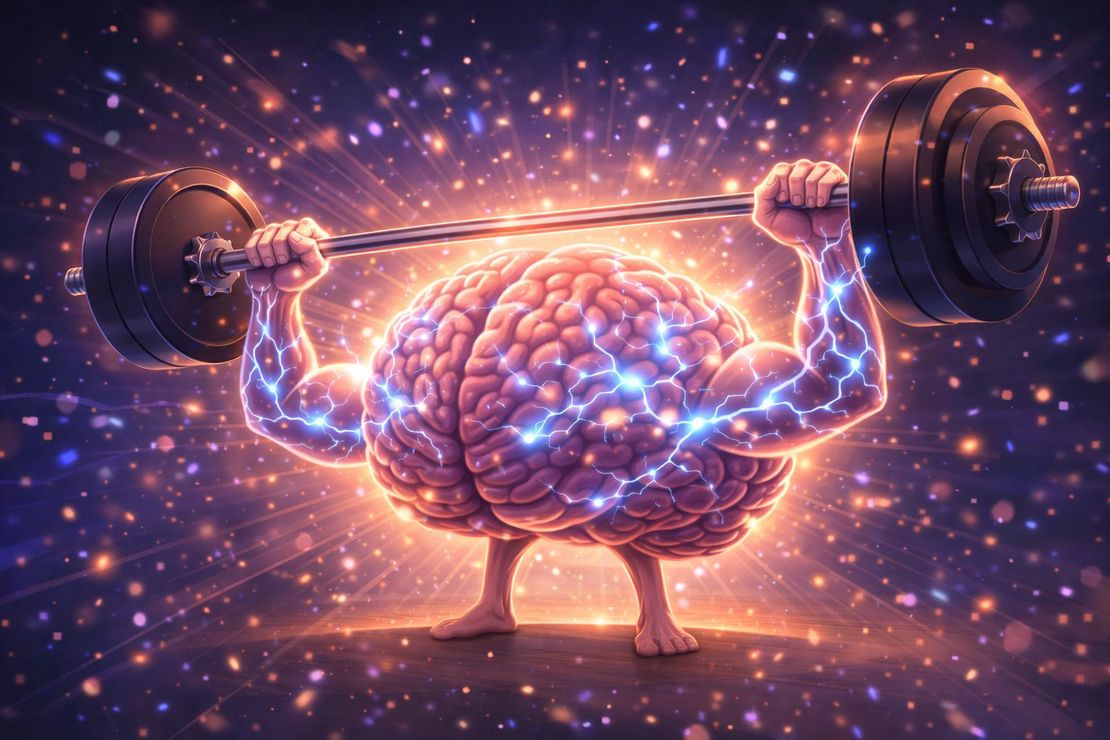
How to Use Neuroplasticity to Change Your Brain and Your Life
This is the second part of my breakdown of neuroplasticity. If you missed it, start with Part 1: What Is Neuroplasticity which covers the science of how your brain rewires itself at the cellular level.
Practical Applications That Matter
The theory is interesting. Here is where it shows up in real life.
Learning a new skill. Whether you want to learn guitar, a new language, or how to code, the same principles apply. Practice with focused attention. Sleep well. Repeat. Vary the difficulty. Your brain handles every skill the same way at the cellular level. The dendrites branch. The myelin wraps. The pathways strengthen. The brain magic behind learning faster is just applied neuroplasticity.
Recovering from brain injury. This is where neuroplasticity gets life-changing. After a stroke or traumatic brain injury, parts of the brain die. But the surrounding regions can, to some extent, take over the lost functions. This is called functional reorganization. Physical therapy after a stroke is essentially a neuroplasticity training program. Patients do thousands of repetitions to coax nearby neurons into forming new pathways. It is slow. It is hard. But it works, often far beyond what doctors once thought possible.
Breaking habits. Habits are physically wired into your brain. That is why willpower alone rarely works. To break a habit, you do not delete the old pathway. You build a new one and let the old one weaken from disuse. This is why replacing a habit works better than just stopping. You need something else for your brain to practice. The identity shift approach to habits is effective because it gives the brain a new pattern to build instead of fighting the old one.
Overcoming limiting beliefs. When you tell yourself “I am bad at math” or “I am not creative,” those beliefs have a physical footprint in your brain. The pathways associated with those thought patterns are strong because you have repeated them. But you can build new pathways through deliberate practice. Each time you try something you thought you could not do and push through the discomfort, you weaken the old pathway and strengthen a new one. The growth mindset research shows this in action: students who learn about neuroplasticity improve their grades because they stop treating their abilities as fixed.
The Limits of Neuroplasticity
I do not want to oversell this. Neuroplasticity is real, but it has limits.
First, you cannot learn anything instantly. Real change takes time and repetition. There is no shortcut. The brain changes slowly because slow change is stable change. Even with perfect practice, rewiring takes weeks or months of consistent effort.
Second, brain damage has real limits. While the brain can compensate remarkably after injury, it does not fully regenerate. A severed spinal cord does not regrow. Massive strokes cause permanent deficits. Neuroplasticity is powerful, but it is not a miracle cure.
Third, your brain’s ability to change declines with age. Not to zero. Far from it. But a 70-year-old brain is genuinely less plastic than a 20-year-old one. The difference is in speed and effort, not in capability. An older brain can still learn new things. It just takes more focused practice.
Fourth, some traits are more genetically constrained than others. Things like IQ, personality, and certain cognitive abilities have a heritable component. You can improve within your range, but you probably cannot transform yourself into a fundamentally different person. The goal is growth, not unlimited transformation.
My Own Experience
I used to say I was “not good with computers.” It was an excuse I used to avoid learning new tech stuff.
But once I learned about neuroplasticity, I started challenging that belief. I forced myself to learn new software, built my own website, figured out how to edit videos.
Was it easy? No. Was it uncomfortable? Yes. But every time I pushed through, I felt smarter. More capable.
Now I do not tell myself I cannot do things. I just tell myself I have not figured out how yet.
Frequently Asked Questions
How long does it take to rewire a habit?
There is no universal number. People often cite 21 or 66 days, but the research shows wide variation depending on the complexity of the habit, how deeply ingrained it is, and the person. Simple habits can form in a few weeks. Complex ones can take months. The key is consistency, not speed.
Does neuroplasticity explain the placebo effect?
Partially. Some placebo effects involve real changes in brain function. When you expect a treatment to work, your brain can activate real physiological responses. This is not “all in your head” in the dismissive sense. It is literally all in your head.
Can I rewire my brain from trauma?
Therapy for conditions like PTSD works partly through neuroplasticity. Treatments like EMDR and exposure therapy help the brain form new associations and weaken traumatic memories. This does not erase what happened, but it can reduce the intensity of the response.
How much of my brain’s wiring is genetic versus learned?
The basic architecture of your brain is genetic. But the fine wiring is shaped by experience. Think of genes as providing the hardware and experience as writing the software. Neither one alone determines the outcome.
Do brain training games work?
Most commercial brain training games do not produce lasting, transferable results. They make you better at the games themselves, but the improvements rarely carry over to other areas. Learning a new language or instrument does more for your brain than any brain training game.
What is the best single thing I can do to support neuroplasticity?
Regular aerobic exercise. Exercise increases brain-derived neurotrophic factor, or BDNF, which is like fertilizer for your neurons. It supports the growth of new connections and protects existing ones. Nothing else comes close in terms of bang for your buck. Exercise combined with learning something new is even more powerful.
The Bottom Line
Your brain is waiting for you to use it. It is capable of incredible growth at any age.
The only real limitation is belief. If you think you cannot learn something, you probably will not. But if you believe you can, and you are willing to put in the work, there is no limit to what you can achieve.
Your brain is ready to grow. Are you ready to challenge it?
Start from the beginning: Part 1: What Is Neuroplasticity
Related Posts

The Simple Mindset Shift That Can Change Your Life Forever
The Simple Mindset Shift That Can Change Your Life Forever When I was in school, I used to think that some people were just smart and others weren’t. You either got math or you didn’t. You were either good at sports or you weren’t. It felt like everyone was born with certain abilities and that was that.
Read MoreWhat Is Neuroplasticity: How Your Brain Rewires Itself at Any Age
What Is Neuroplasticity: How Your Brain Rewires Itself at Any Age I used to think that once you became an adult, your brain was basically done. You were who you were. You could not really get smarter or learn new things as easily as when you were young.
Read More
The Brain Magic Behind Learning Faster (And How to Use It)
The Brain Magic Behind Learning Faster (And How to Use It) I’ve always been curious about why some people seem to learn impossibly fast. You know the type. The friend who picks up a new language in three months. The colleague who masters a complex software tool over a weekend. I used to think they were just gifted. Born with better brains.
Read More