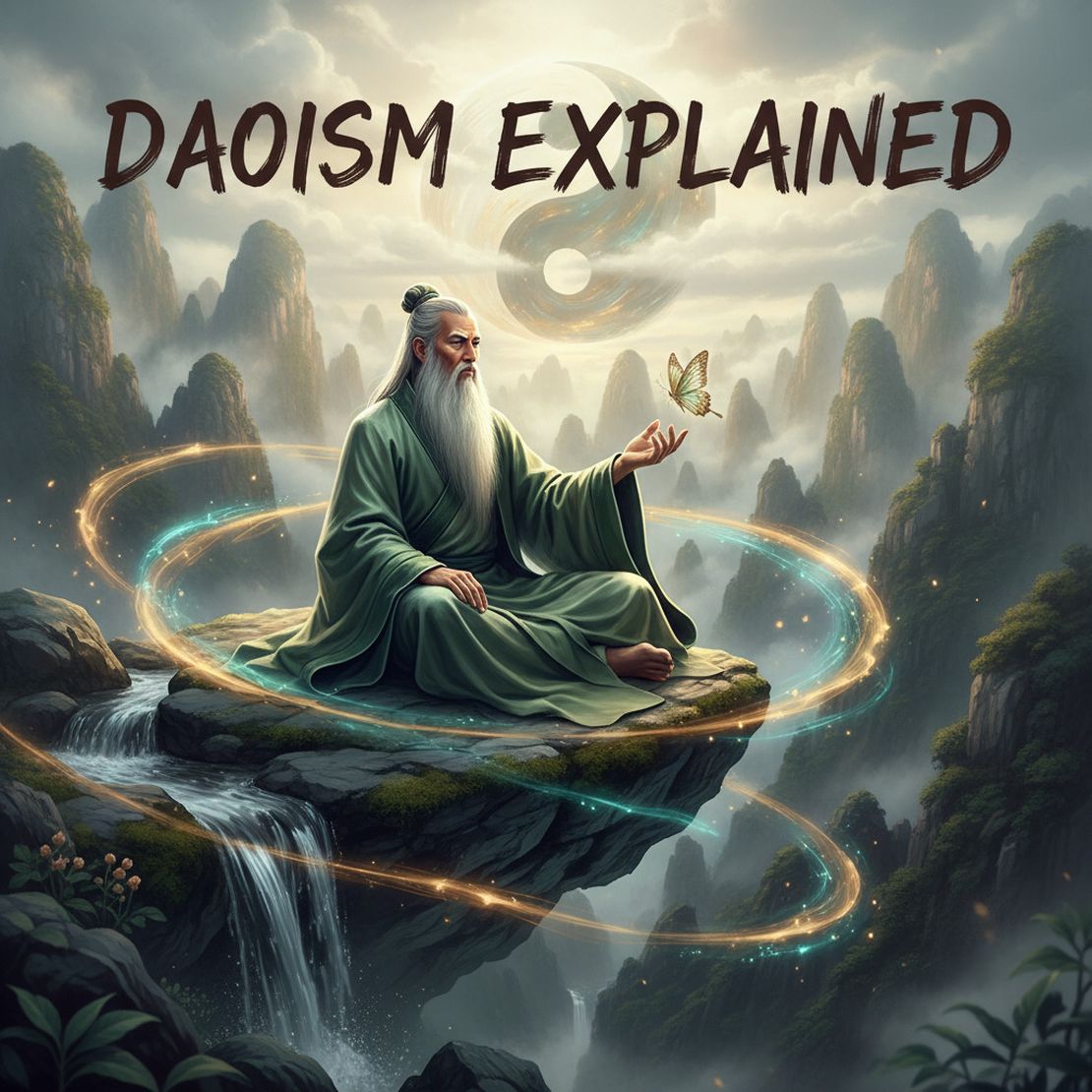
This is part 1 of a two-part series on Daoism. Read part 2: History, Religious Practice and Daily Life →
What is Daoism? Core Philosophy, Foundational Texts, and Key Concepts
I remember the first time I tried to read the Tao Te Ching. I was in college, and a friend told me it would change my life. I opened it, read the first line: “The Dao that can be spoken of is not the eternal Dao.” Then I closed it again. I had no idea what I was looking at.
That confusion turned out to be the point. Daoism (often spelled Taoism) is one of those subjects that seems simple until you actually try to pin it down. Is it a philosophy? A religion? Both? Neither? The answer depends on who you ask and what century you are talking about.
Daoism is one of the “Three Teachings” (San Jiao) of China, standing alongside Confucianism and Buddhism as a cultural pillar. Its influence runs through Chinese medicine, martial arts, literature, politics, and art. But in the West, we tend to get it wrong in predictable ways. Some people treat it as a gentle lifestyle philosophy, all harmony and flow, with none of the messy religious stuff. Others hear “Tao” and think of a mystical force from Star Wars. Neither is accurate. For a look at how Buddhism handles similar questions, see the Bhavacakra guide to Buddhism’s wheel of life.
This part covers the philosophy, the key texts, and the core concepts. Part 2 covers the history, religious practices, and how to apply Daoism today.
Defining “The Dao”: The Metaphysical Foundation
To understand Daoism, you have to wrestle with the concept of The Dao (or Tao). The word translates to “The Way” or “The Path.” That is like saying the ocean is wet. Technically correct, but it misses the scope.
The Dao is the ultimate creative principle of the universe. It is the source of everything that exists and the rhythm by which the cosmos operates. More importantly, the Dao is ineffable. It cannot be captured in words or concepts. That is why the Tao Te Ching opens with a line designed to frustrate a rationalist: “The Dao that can be spoken of is not the eternal Dao.”
This is not wordplay. It is a genuine philosophical position. Daoists argue that language chops reality into pieces: this and that, good and bad, being and non-being. In doing so, it misses the unified whole that underlies everything. The Dao is that whole. You cannot talk about it because talking requires separation.
I used to find this frustrating. Now I find it liberating. The goal is not to define the Dao. The goal is to align with it.
The Problem of Translating Daoism to the West
Before I go further, I need to address something that caused me a lot of confusion early on. Most of what Westerners read about Daoism comes through translation, and translation is never neutral.
The Wade-Giles romanization system gave us “Taoism” and “Tao Te Ching.” The newer Pinyin system gives us “Daoism” and “Daodejing.” Both refer to the same tradition. I use “Dao” and “Daoism” in this article because that is the contemporary academic standard, but the older spellings are not wrong.
The deeper problem is conceptual. Daoist ideas were developed in a language and culture that does not share Western assumptions about reality. When a Chinese text says “wu wei,” translating it as “non-action” is technically accurate but practically misleading. A Western reader hears “do nothing” and thinks of laziness. That is not what the text means at all.
Origins and Foundational Texts
The Daoist tradition rests on two primary texts that emerged during the Warring States Period (4th-3rd Century BCE), a time of constant warfare and political upheaval in China.
The Daodejing (Tao Te Ching)
The Daodejing is attributed to Laozi (Lao Tzu), whose name means “Old Master.” Whether Laozi was a historical person or a composite figure is debated. The text is short, about 5,000 Chinese characters, and consists of poetic stanzas that serve as a manual for both self-cultivation and political governance.
The central advice runs counter to everything we assume about leadership. Where Confucians argued for more rules and more active government, Laozi argued for less. Let things be. Stop forcing. The best ruler is the one the people barely notice.
The Zhuangzi
The Zhuangzi, attributed to Zhuang Zhou, is a very different kind of book. Where the Daodejing is compressed and aphoristic, the Zhuangzi is expansive, funny, and weird. It uses parables and absurd scenarios to make its points.
The most famous passage is the “Butterfly Dream.” Zhuangzi dreams he is a butterfly with no awareness of being Zhuangzi. Then he wakes up and is Zhuangzi again. Now he cannot be sure: is he Zhuangzi who dreamed of being a butterfly, or a butterfly dreaming he is Zhuangzi? The point is to question whether our ordinary sense of identity is as solid as we assume. This connects to what Alan Watts called map-territory confusion.
Core Philosophical Concepts
Wu-Wei: Effortless Action
This is probably the most misunderstood Daoist concept in the West. People hear “non-action” and picture someone doing nothing in a cave. The reality is almost the opposite.
Wu-Wei means acting without forced effort. Not doing nothing, but doing things in a way that fits the natural flow. Water flowing around a rock is wu-wei. A skilled musician who no longer thinks about the notes is wu-wei. It is the same state athletes describe as being “in the zone.” I have written about this in my guide to the flow state, and it overlaps with the Japanese concept of mushin, or no-mind.
The practical test: if you are trying hard and getting nowhere, you might be fighting the current. The Daoist answer is not to try harder. It is to step back, observe, and find the path of least resistance.
Ziran: Naturalness
Ziran translates to “self-so” or “naturalness.” It describes the state of being what you are without artificial distortion. A tree grows as a tree. Water flows downhill. A person who has cultivated ziran acts from their genuine nature rather than from social conditioning.
This sounds simple but is difficult. Most of us spend years learning how to behave and meet expectations. Ziran is the unlearning of all that.
Pu: The Uncarved Block
Pu literally means “uncarved wood” or “raw timber.” It is a metaphor for the original, unshaped state of consciousness. A block of wood has infinite potential. Once you carve it into a specific shape, it loses that potential.
Confucianism was all about carving: shaping people through ritual, education, and hierarchy. Daoism pushes back. The uncarved block represents the value of keeping yourself open, simple, and unforced.
Yin and Yang
Everyone has seen the yin-yang symbol. Most people think it is about balance. It is not really about balance. It is about how opposites depend on each other and arise from each other. Light only makes sense because of dark. Action only exists against a background of stillness.
Daoism emphasizes the yin side: feminine, dark, soft, yielding. The strong survive, but the flexible thrive.
Daoism vs Confucianism: The Original Rivalry
You cannot understand Daoism without understanding Confucianism. Both developed in the same period and came to radically different conclusions.
Confucianism says: society is a mess because people do not follow the rules. The solution is more education, more ritual, more clearly defined social roles.
Daoism says: society is a mess because people have too many rules. The solution is to strip away artificial constraints and let people find their own way.
This is a fundamental split about human nature. Confucians believe people need structure. Daoists believe people need freedom from structure. Both traditions have coexisted for over two thousand years, and most Chinese people have drawn from both at different times.
FAQ
Is the Tao Te Ching hard to read? The text is short and poetic. The challenge is that it was written in a different language, culture, and historical context. A first reading will likely confuse you. Read it multiple times spread out over months.
What is the best translation of the Tao Te Ching? There is no single best answer. Stephen Mitchell’s version is poetic but loose. Gia-Fu Feng and Jane English’s version is clear. Derek Lin’s version is more literal. Read two or three and compare.
How is Daoism different from Buddhism? Both emphasize letting go of attachment. But Buddhism frames this in terms of suffering and rebirth, while Daoism frames it in terms of aligning with the natural order.
Read next: Daoism Through History: Religion, Practice and Daily Life →
Related Posts
Miyamoto Musashi's Dokkōdō: The Life of a Ronin and Principles 1-7
Miyamoto Musashi’s Dokkōdō: The Life of a Ronin and Principles 1-7 I remember the first time I read the Dokkōdō. It was late at night, I was feeling stuck, and I stumbled across this list of 21 precepts written by a 17th century Japanese swordsman. I expected a warrior code about fighting and honor. What I found was something stranger: a guide to being alone, a philosophy of radical self-reliance, and a surprisingly practical system for navigating modern life.
Read More
Stoicism in Practice: Daily Exercises, Common Misconceptions and FAQ
This is part 2 of a two-part series on Stoic wisdom. Read part 1: The Stoic Framework for Peace ←
Read More
How to Find Your Ikigai: The Japanese Secret to a Long and Happy Life
How to Find Your Ikigai: The Japanese Secret to a Long and Happy Life Have you ever wondered what the secret is to a life filled with purpose, happiness, and longevity? The answer might lie in a concept from the island of Okinawa, Japan—a place famous for having the highest concentration of centenarians in the world. This concept is called Ikigai.
Read More