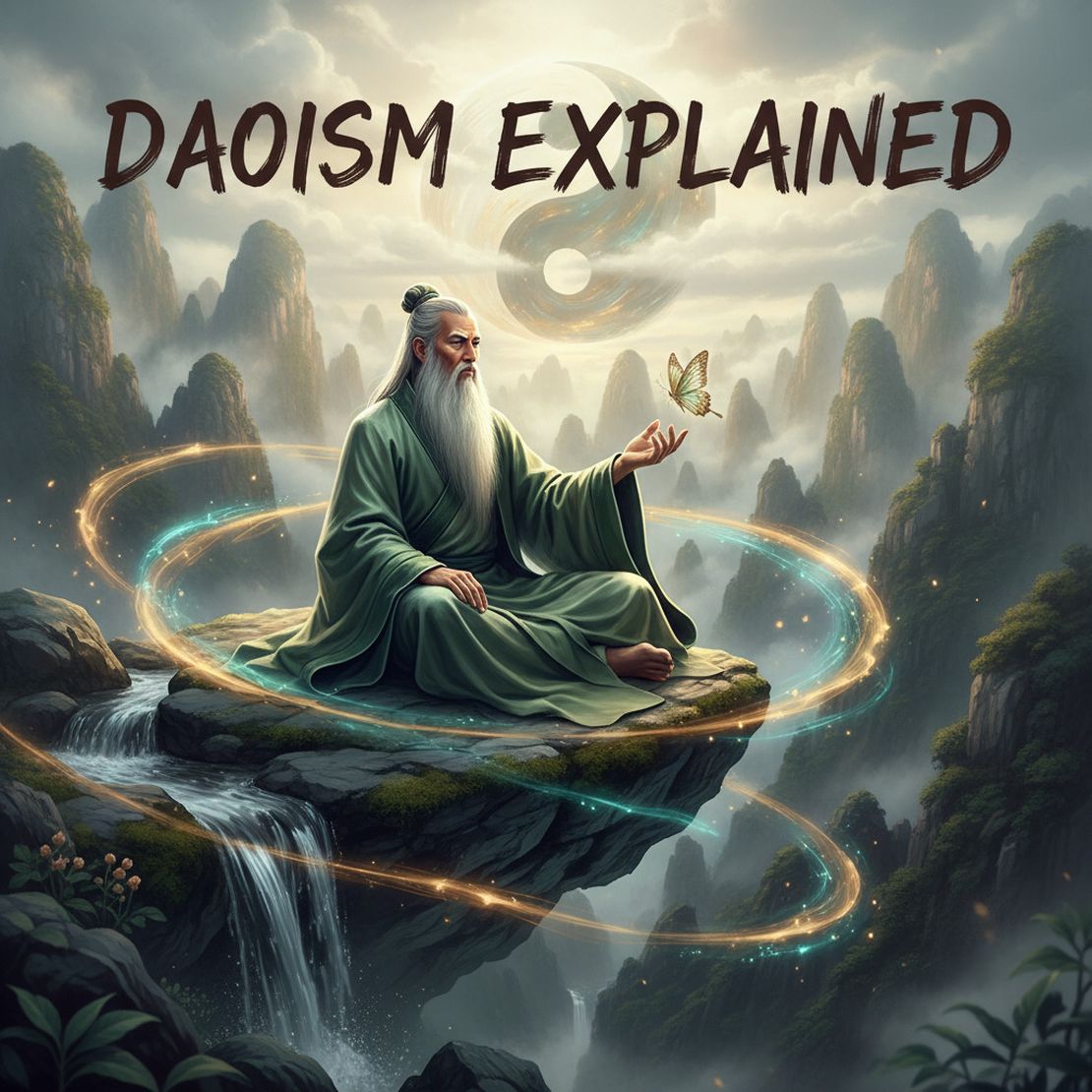
This is part 2 of a two-part series on Daoism. Read part 1: Core Philosophy, Foundational Texts, and Key Concepts ←
Daoism Through History: Religion, Practice and Daily Life
In part 1, I covered the philosophy of Daoism: the Dao, wu wei, ziran, the uncarved block, and yin-yang. Now let me cover the history, the religious practices, and what any of this means for daily life.
Historical Development
Daoism developed over centuries, responding to changing political and social conditions.
Warring States Period (475-221 BCE): The earliest Daoist ideas emerged during this chaotic time. The Daodejing and the Zhuangzi were written, probably by multiple authors over generations. These texts were part of a broader explosion of Chinese philosophy that historians call the Hundred Schools of Thought.
Han Dynasty (206 BCE-220 CE): Daoism began to organize as a religion. In 142 CE, Zhang Daoling claimed to receive a revelation from the deified Laozi and founded the “Way of the Celestial Masters” (Tianshi Dao), the first organized Daoist religious institution with priests, hierarchy, and rituals. This is where philosophical and religious Daoism began to merge.
Six Dynasties and Tang (220-907 CE): Daoism flourished. The Tang dynasty considered it a state religion. Monasteries were built across the country, texts were collected into a canon, and practices like internal alchemy were developed. This period produced the Daoist Canon (Daozang).
Song Dynasty (960-1279): The integration of Daoism with Buddhism and Confucianism accelerated. Neo-Confucianism emerged, absorbing Daoist metaphysical concepts while maintaining Confucian ethics.
Yuan and Ming Dynasties (1271-1644): The Quanzhen (Complete Perfection) school emerged, emphasizing monasticism and internal alchemy over ritual-heavy approaches.
Qing Dynasty to Present (1644-present): Daoism declined during the Qing, then suffered severe persecution during the Cultural Revolution (1966-1976), when temples were destroyed. Since the 1980s, there has been a steady revival. Daoism is now practiced openly in China and has spread to the West.
Modern scholars largely reject the older split between “Philosophical Daoism” and “Religious Daoism.” Religious concerns like immortality show up in the earliest texts, and philosophical reflection never disappeared from religious Daoism.
Religious Practices: The Quest for Immortality and Harmony
A central goal of religious Daoism is longevity and, ultimately, immortality (Xian).
Qi: The Vital Energy
Daoists believe the universe is made of Qi (vital energy) and that the human body is a miniature version of the universe. By preserving, purifying, and circulating Qi, practitioners maintain health and progress spiritually.
Qi practices include breath exercises, movement practices like Daoyin (which later influenced Qigong and Taiji), and meditation techniques that direct awareness through the body. I have found the consciousness circulation practice from The Secret of the Golden Flower to be the most practical entry point.
External and Internal Alchemy
The pursuit of immortality led to two approaches.
Waidan (External Alchemy): The attempt to create physical elixirs from minerals like cinnabar, gold, and arsenic. It did not work. Many Chinese emperors died from heavy metal poisoning. The practice largely faded.
Neidan (Internal Alchemy): This approach uses meditation, breath control, and visualization to refine internal energies. The “ingredients” are Jing (essence), Qi (vital energy), and Shen (spirit). The goal is to reverse decline and create an “immortal embryo” within the body. Read as metaphor, it describes a detailed system of psychosomatic training.
The Daoist Pantheon and Rituals
Religious Daoism developed a vast pantheon and elaborate ritual system.
The Pantheon: At the top sit the Three Pure Ones, representing manifestations of the Dao. Below them is the Jade Emperor, who oversees the celestial bureaucracy. Below are countless gods and immortals, many absorbed from local traditions.
The Priesthood: Daoist priests (Daoshi) are ritual specialists who mediate between the human community and the spirit world. Their training includes liturgy, music, and complex rituals.
Major Rituals: The Jiao (Offering) ceremony renews a community’s relationship with the gods. The Zhai (Purification) involves fasting and cleansing to restore cosmic balance.
Putting Daoism into Practice
For me, the value of Daoism is in what you actually do differently.
Wu-Wei in Daily Life
I try to apply wu-wei when I feel stuck. The instinct is to push harder. The Daoist approach is to stop, observe, and find the path that does not require force. This applies to creative blocks, difficult conversations, and decisions where no option feels right.
A simple test: if pushing harder is making things worse, stop pushing. Wait. See what changes without your intervention.
Embracing Simplicity
Pu, the uncarved block, has practical implications. I have simplified my possessions, commitments, and information intake. Not because minimalism is virtuous but because complexity creates friction. The less I have to manage, the more energy I have for what matters. This idea shows up in other traditions too. The concept of a controlled accident teaches a similar lesson about letting go of control.
Ziran in Relationships
The hardest application is ziran. Stop performing. Stop managing people’s impressions. Say what you actually think. This is terrifying at first. It also eliminates an enormous amount of wasted mental energy.
FAQ
Is Daoism a philosophy or a religion? Both. Philosophical Daoism focuses on texts and self-cultivation. Religious Daoism includes gods, rituals, and the pursuit of immortality. In China these have never been fully separate.
Can I practice Daoism without believing in gods? Yes. Many Western practitioners engage with Daoism as a philosophy and set of practices without accepting the religious framework. The classical texts do not require belief in deities.
How is Daoism different from Confucianism? Confucianism believes people need structure, rules, and social hierarchy. Daoism believes people need freedom from artificial constraints. Both have coexisted in China for over two thousand years, with most people drawing from both at different times.
What is the single most useful Daoist concept for daily life? Wu-wei. When you feel stuck or like you are forcing something, stop. Observe the situation. Find the path that does not require force. This simple shift saves enormous energy.
Read previous: What is Daoism? Core Philosophy, Foundational Texts, and Key Concepts ←
Daoism blends metaphysics, political theory, medicine, and religious ritual. Whether you approach it through the Zhuangzi or the ritual of a Celestial Master priest, the core aim stays the same: to align yourself with the Dao and find harmony with the natural flow of the universe.
Related Posts
Stop Wanting, Start Accepting: The Stoic Framework for Peace
This is part 1 of a two-part series on Stoic wisdom. Read part 2: Stoicism in Practice: Exercises, Misconceptions and FAQ →
Read More
Miyamoto Musashi's Dokkōdō: The Life of a Ronin and Principles 1-7
Miyamoto Musashi’s Dokkōdō: The Life of a Ronin and Principles 1-7 I remember the first time I read the Dokkōdō. It was late at night, I was feeling stuck, and I stumbled across this list of 21 precepts written by a 17th century Japanese swordsman. I expected a warrior code about fighting and honor. What I found was something stranger: a guide to being alone, a philosophy of radical self-reliance, and a surprisingly practical system for navigating modern life.
Read MoreHow to Apply Miyamoto Musashi's Dokkōdō to Modern Life
How to Apply Miyamoto Musashi’s Dokkōdō to Modern Life This is the third and final part of my breakdown of the Dokkōdō. Read Part 1: Life and Principles 1-7 and Part 2: Principles 8-18 and Stoicism first.
Read More